Pooja Unit Cost in Hyderabad: 2026 Design Price Guide
A comprehensive, non-promotional guide to pooja unit costs in Hyderabad. Learn how layout choices, materials (BWP IS 710 vs. BWR/MR IS 303 vs. HDHMR), CNC cutwork, onyx backlighting, electrical safety, and ventilation guidelines shape your final estimate.
In Hyderabad’s residential architecture, the pooja room or mandir unit is far more than a decorative furniture piece. It represents the spiritual heart of the home, a sanctuary of peace, and a critical component of Vastu Purusha Mandala compliance. As Hyderabad has expanded rapidly into high-rise residential hubs across Gachibowli, Tellapur, Kokapet, Manikonda, Narsingi, Miyapur, and the Financial District, the way we design and accommodate pooja units has fundamentally evolved.
In modern apartments built by prominent regional developers such as My Home Group, Aparna Constructions, Rajapushpa Properties, Prestige, and Vasavi, dedicated space for a traditional, independent room is often at a premium. Homeowners are frequently presented with a designated wall niche, an alcove in the dining area, or a compact corner in the living room. Consequently, designing a pooja unit in 2026 requires balancing traditional craftsmanship—such as solid teak wood frames and brass CNC lattices—with modern space-saving engineering like wall-mounted floating cabinets, backlit translucent marble backdrops, and automated indirect LED lighting.
However, when requesting interior design quotes, homeowners often face extreme price variability. A simple wall-mounted mandir can cost as low as ₹15,000, while a custom-designed, dedicated pooja room with solid teak wood carvings, CNC-cut brass jaalis, and backlit onyx cladding can easily exceed ₹2,00,000 (and reach up to ₹5,00,000+ for large villas or extensive stonework).
This guide breaks down these costs transparently. We will analyze the core variables—sizes, materials, decorative elements, electrical systems, and safety compliance—so you can budget effectively for your Hyderabad home.
Pooja Unit Types & 2026 Cost Matrix
The final cost of a pooja unit is primarily determined by its structural layout and scale. Below, we categorize the three most popular design formats found in Hyderabad apartments and standalone villas.
A. Wall-Mounted Niches / Floating Mandirs
Best suited for compact 2BHK apartments (1,000 to 1,300 sq ft) in areas like Manikonda, Miyapur, and Alwal, or where floor space must be conserved. These units typically feature a floating bottom drawer unit for storage of pooja items, a flat deck for deities, and a decorative CNC backdrop or a small wooden arch.
- Typical Dimensions: Width: 2 to 3 feet | Height: 3 to 4 feet | Depth: 12 to 18 inches.
- Average Cost Range: ₹15,000 to ₹25,000 (MDF / commercial MR ply with basic CNC jaali).
B. Freestanding Timber Temples / Cabinets
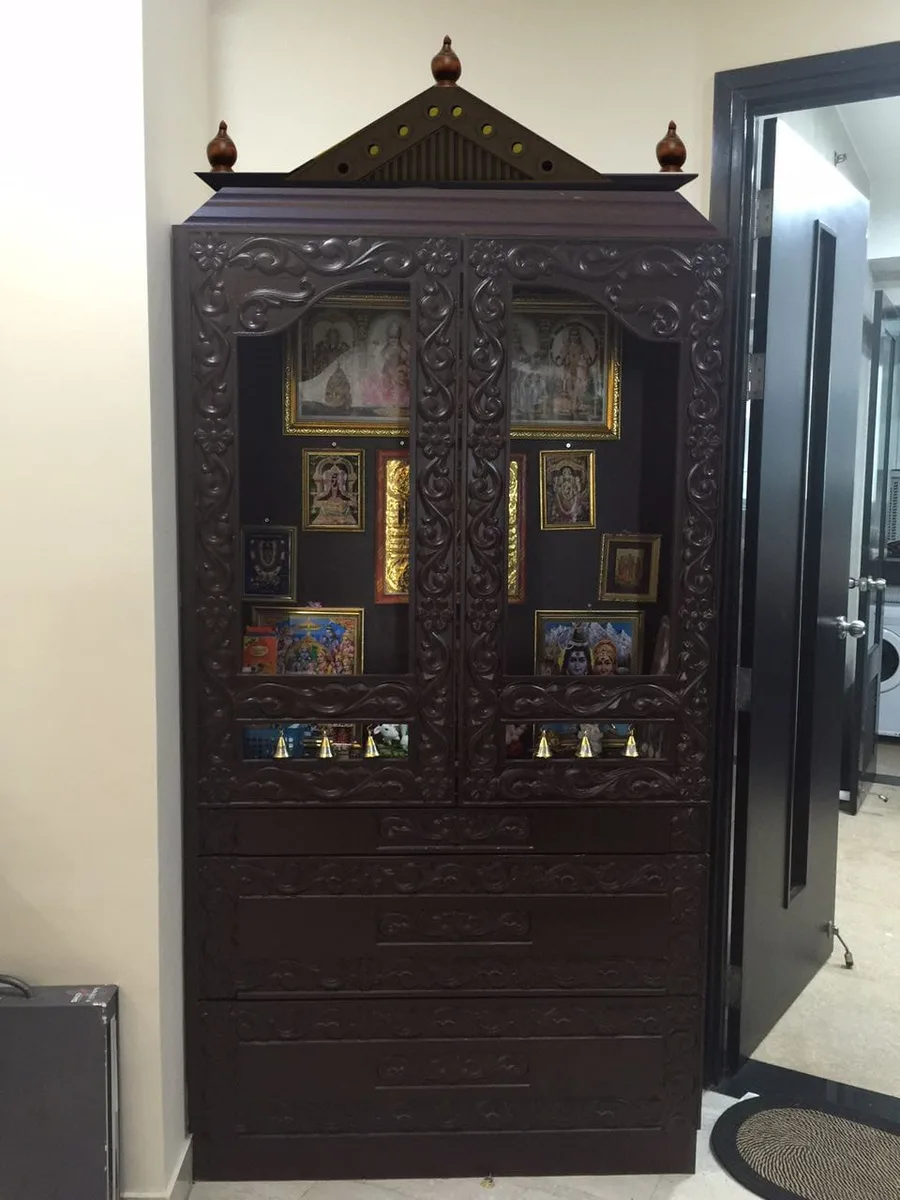
A semi-portable, floor-standing unit that can be placed in a dedicated corner of the living room, dining room, or a wide corridor. These units are popular among tenants and homeowners who want the option to move the mandir in the future. They feature comprehensive storage drawers, slide-out brass trays for incense, and side screens.
- Typical Dimensions: Width: 3 to 4 feet | Height: 5 to 6 feet | Depth: 18 to 24 inches.
- Average Cost Range: ₹30,000 to ₹50,000 (Veneer finish over HDHMR/BWR plywood with moderate solid wood detailing).
C. Dedicated Pooja Rooms with Designer Doors
Standard in spacious 3BHK and 4BHK apartments (1,800 to 3,500+ sq ft) in upscale micro-markets like Kokapet, Tellapur, Jubilee Hills, and Gachibowli (e.g., My Home Bhooja, Aparna Sarovar Zenith, Rajapushpa Provincia). This configuration utilizes an entire room or deep alcove, complete with custom-carved double doors (often featuring brass bell inserts or glass panels), complete wall cladding, custom step-pedestals for idols, and elaborate backlit ceilings.
- Typical Dimensions: Width: 4 to 6+ feet | Height: 7 to 9 feet (ceiling height) | Depth: 3 to 5+ feet.
- Average Cost Range: ₹75,000 to ₹1,50,000 for a premium deep-alcove unit, and ₹2,00,000 to ₹5,00,000+ for a full dedicated room with marble cladding, Burma teak doors and onyx backlighting (see the matrix below).
2026 Price Breakdown Matrix by Specification Level
| Design Format | Core Carcass & Substrate | Shutter & Backdrop Finishes | Average Cost Range | Cost Factors |
|---|---|---|---|---|
| Basic Wall Niche | MDF / Commercial MR Ply | Laminate finish, basic CNC MDF jaali, standard spotlights | ₹15,000 – ₹25,000 | Flat-packed or basic site-built unit, standard manual drawer rails |
| Standard Freestanding | HDHMR / BWR Plywood | Teak wood veneer, acrylic jaali backdrop, soft-close drawers | ₹30,000 – ₹50,000 | Custom sizing, slide-out bhog/prasad tray, integrated warm cove LEDs |
| Premium Custom Unit | BWP Marine Plywood | Solid teak wood frame, brass CNC panels, marble/onyx backlighting | ₹75,000 – ₹1,50,000 | Custom carvings, high-grade stone work, soft-close hardware, profile lights |
| Luxury Dedicated Room | BWP Marine Plywood & Solid Teak | Full marble wall cladding, Burma teak double doors with brass bells, onyx stone backdrop, smart lighting | ₹2,00,000 – ₹5,00,000+ | High-end civil modifications, heavy structural stone work, customized Vastu layouts |
Basis: AlcorOne execution rates as of , exclusive of GST. Indicative range for planning; the binding figure comes from an itemised BOQ against the actual site measurements and specification.
Note: All estimated costs exclude GST (18% on interior services) and loose brass deity idols or custom silverware. Between the premium unit's ₹1,50,000 ceiling and the luxury room's ₹2,00,000 floor, the figure depends on how much of the luxury specification is added (marble cladding, Burma teak doors, onyx backdrop), so a unit in that range is priced from its itemised BOQ rather than a band.
Core Materials: Balancing Durability & Vastu Needs
Selecting the correct core substrate is critical for a pooja unit. Unlike standard living room TV units, pooja units are subjected to unique environmental stressors: heat from oil lamps (diyas), smoke from incense (dhoop), and water/milk spills during daily rituals (abhishekam).
Additionally, many pooja units share walls with bathrooms or wet utility zones, particularly in high-rise builder layouts from developers like Prestige and My Home. Moisture seepage can quickly warp cheap materials.
Carcass Materials: BWP vs. BWR vs. HDHMR vs. Commercial MR Plywood
Understanding which board to use is the key to preventing long-term structural failures:
- Boiling Water Proof (BWP) Marine Plywood (IS 710): Manufactured using high-grade, undiluted phenol-formaldehyde synthetic resin. This is the gold standard if your pooja room shares a wall with an attached bathroom or utility balcony. It is highly water-resistant and resists delamination under repeated exposure to moisture from cleaning or liquid offerings. Cost Impact: High (typically 30% more than commercial ply).
- Boiling Water Resistant (BWR) / Moisture Resistant (MR) Plywood (IS 303): Standard commercial-grade plywood bonded with synthetic resins. BWR is suitable for standard dry rooms with minor moisture exposure. MR Plywood is a budget-friendly option but should only be used for dry vertical partition panels or storage cabinets that do not touch bathroom-adjacent walls. Cost Impact: Moderate.
- High-Density High-Moisture Resistant (HDHMR) Board: An engineered wood substrate made from highly compressed hardwood fibers blended with moisture-resistant resins. HDHMR has an incredibly smooth, flat surface, making it the perfect substrate for high-gloss acrylic sheets, polyurethane (PU) paint, and direct CNC routing. It holds its shape well near the gentle heat of lamps. Cost Impact: Moderate. Highly cost-effective for CNC jaalis and painted panels. Caution: Do not submerge in water.
Solid Wood Elements: Teak Wood Options
For the outer frame, pillars, arches, and custom double doors, solid wood is the preferred choice for its Vastu compatibility and longevity.
- Central Province (CP) Teak: Sourced from central India, it has a dense grain, beautiful golden-brown color, and excellent durability. It is the most common choice for premium frames in Hyderabad. Cost: ₹2,800 to ₹3,500 per cubic foot (CFT).
- Burma Teak: Sourced from Myanmar, it is the most premium wood available. It has a high oil content, making it virtually immune to termites and rot, and features a clean, straight grain pattern. Cost: ₹6,000 to ₹9,000+ per CFT.
- Teak Wood Veneers (0.5mm to 1mm): If solid teak is outside your budget, applying a natural teak veneer over an HDHMR or plywood carcass gives the identical visual warmth of solid wood at a fraction of the cost.
Decorative Elements: Jaalis, Stone Claddings, and Backlighting
The visual signature of a modern pooja unit lies in its backdrop and screens. These decorative accents often represent 40% to 60% of the total unit cost.
Decorative Element Cost Guide
| Material / Element | Cost Range (per Sq Ft) | Aesthetic Style & Properties |
|---|---|---|
| MDF CNC Jaali | ₹250 – ₹450 | Traditional, paintable, budget-friendly |
| WPC / Acrylic CNC | ₹450 – ₹850 | Modern, washable, highly durable |
| Solid Brass CNC Cutting | ₹2,500 – ₹5,000 | Ultra-Premium, heavy, auspicious in Vastu |
| Onyx Stone (Backlit) | ₹950 – ₹2,500 | Luminous, luxurious, premium natural pattern |
| Engraved Corian (Acrylic) | ₹800 – ₹1,800 | Minimal, seamless, exceptionally easy to clean |
| Italian Marble Cladding | ₹600 – ₹1,500 | Classic temple look, cool and solid feel |
CNC Jaali Cutwork
CNC (Computer Numerical Control) routing allows for intricate lattice patterns, such as Om symbols, Kalash designs, bells, and geometric floral grids.
- MDF CNC Jaalis: Budget-friendly, but require paint finishing (typically duco or PU paint). If exposed to too much heat or soot, they can discolor and are difficult to clean.
- Acrylic CNC Jaalis: Waterproof, easy to wipe down, and available in gold, silver, and wood-grain finishes. They are highly durable.
- Solid Brass CNC Cutting: The ultimate luxury option. Brass is considered highly auspicious in Vastu. It does not rust, has a rich weight, and shines under spotlights. However, brass plates are heavy and require reinforced wooden frames to hold them.
Stone Claddings & Backlit Backdrops
Adding a natural stone backdrop transforms the space, mimicking the sanctum of a temple.
- Onyx Marble: A semi-precious, translucent natural stone that allows light to pass through. When backlit with warm LED panels, the natural veins of the onyx glow, creating a serene, temple-like ambiance. It is highly priced and requires careful installation to avoid fracturing.
- Corian (Solid Surface): An acrylic-based solid surface material. It can be seamlessly joined without grout lines and is easily engraved with detailed Vastu patterns. When backlit, it glows uniformly. It is highly hygienic, non-porous, and exceptionally easy to wipe clean of oil soot.
- Natural Indian Marbles (Makrana / Ambaji): Ideal for traditional white stone pedestals and wall panels. They provide a cool, clean surface.
Lighting and Electrical Systems: Creating a Sacred Glow
Lighting in a pooja room is not just about visibility; it sets the mood for meditation and prayers. A well-designed electrical layout avoids harsh glare and highlights the architectural details of the unit.
Recommended Lighting Formats
- Indirect Cove Lighting: Warm white (2700K to 3000K) LED strip lights hidden behind the ceiling plasterboard or the back panel. This creates a soft halo effect without cast shadows.
- Spotlights: Low-wattage, narrow-beam spotlights (2W to 3W) focused directly onto the central deity idols. Avoid cool blue or bright daylight bulbs, as they disrupt the traditional sanctuary vibe.
- Backlight Panels: Acrylic diffuser sheets or translucent stones lit from behind by closely spaced LED strips. To avoid "hot spots" (visible lines of light), the LEDs must be placed at least 3 inches behind the translucent material with a proper diffuser sheet in between.
Vastu-Compliant Lighting Guidelines
According to Vastu principles, the lighting source should ideally be positioned in the east or north wall of the pooja room. Avoid placing heavy light fixtures directly over the center of the deity idols; instead, offset them slightly to illuminate the face of the deity from the front.
Fire & Electrical Safety Guidelines for Pooja Units
Because pooja units routinely involve open flames (diyas, camphor) and smoke (incense, dhoop) alongside multiple electrical fittings, they pose unique fire and air-quality hazards. Following sound fire and electrical safety practice is critical to protecting your family.
Important Safety Notice: The practices below are aimed at preventing electrical shorts and open-flame fire propagation in small enclosed niches. Following them is essential when utilizing wood and paper backdrops.
Electrical Safety Guidelines
- Conduit Installation: All wiring behind wooden claddings or inside CNC panels must run through heavy-duty, flame-retardant (FR-LSH) rigid PVC conduits. Loose, un-conduited wiring behind wooden panels is a major cause of residential fires.
- Heat Dissipation: Backlit panels (Onyx or Acrylic) must include ventilation slots at the top and bottom to allow heat generated by the LED strips to escape. Excessive heat buildup reduces LED lifespan and degrades the adhesive backing, creating a short-circuit risk.
- Isolating Circuits: The pooja room's electrical circuit should be connected to a dedicated miniature circuit breaker (MCB) in the main distribution board, allowing you to isolate the zone during long vacations.
Ventilation and Smoke Control
- Natural Ventilation: If the pooja unit is in a dedicated room, a common planning guideline is a window opening of about 10% of the floor area, so smoke from incense can escape.
- Mechanical Ventilation: In high-rise apartments where the pooja room is enclosed or lacks a window, a low-noise inline exhaust fan (connected to a ventilation duct or building shaft) is highly recommended. This prevents carbon monoxide and particulate matter from incense smoke from building up in the living areas.
- Clearance from Open Flame: As a planning practice, keep a minimum clearance of 18 inches (1.5 feet) between the top of an open oil lamp (diya) and any wooden ceiling, veneer panel, or CNC jaali. If clearance is less, mount a fireproof metal plate (like brass or copper) or a tempered glass sheet on the underside of the wooden canopy.
Spatial Design & Vastu Planning in Hyderabad Apartments
Vastu Shastra is highly prioritized by homeowners in Hyderabad. In apartments built by My Home (e.g., My Home Tarkshya, My Home Mangala) and Aparna (e.g., Aparna Alora, Aparna Sarovar Zenith), developers usually pre-align the floor plans to support a Vastu-compliant layout. However, custom interior design must maintain these guidelines during execution.
Vastu Layout Best Practices
- Directional Placement: Per common Vastu practice, the pooja unit should ideally face North-East (Ishanya corner), East, or North, and the devotee should face East or North when praying.
- Proximity Rules: Many households prefer that a pooja unit not share a wall with a bathroom, nor sit directly under or opposite a toilet. If the builder layout places the pooja unit on a wall sharing plumbing lines, you must install an independent moisture-barrier board (like a marine ply backing with a vapor barrier membrane) to physically isolate the mandir carcass.
- Pedestal Height: The base of the platform where the deities are placed should be high enough so that the feet of the idols are aligned with the chest level of the devotee when praying (typically 28 to 32 inches from the finished floor level).
Storage and Utility Management
A functional pooja unit requires smart storage to keep the prayer space clutter-free.
- Soft-Close Drawers: Incorporate soft-close drawer runners (such as Ebco or Hettich) for the bottom cabinets. This ensures that opening and closing drawers for matchboxes, cotton wicks, and oil does not cause vibrations that shake the deity idols.
- Bhog Tray: Integrate a slide-out tray directly beneath the main deck to serve as a platform for food offerings (prasad) or to hold the prayer book during rituals. This tray should be lined with a laminate or acrylic top sheet for easy cleaning of food spills.
- Oil Drawer: Designate a deep, pull-out bottle organizer lined with a removable stainless steel or acrylic tray to store oil bottles. This protects the wooden cabinet bottom from inevitable oil leaks and staining.
Illustrative Hyderabad Examples & Cost Optimization
To see how these costs add up, here are two illustrative worked examples for typical Hyderabad flats. They are planning examples built from the rates above, not records of specific AlcorOne jobs.
Illustrative Example 1: A Modern Niche in a Typical Puppalaguda Apartment
- The Scope: An illustrative example for a typical 2.5BHK flat in Puppalaguda: a compact pooja alcove in the dining area.
- The Design: A floating HDHMR cabinet with a warm teak veneer finish, an acrylic CNC-cut backlit backdrop, and two small spotlights.
- Cost Breakdown:
- HDHMR Cabinetry with Teak Veneer: ₹18,000
- Acrylic CNC Backdrop (3x4 ft) with Diffuser: ₹8,000
- LED Lighting & Wiring (FR-LSH conduits): ₹4,000
- Installation & Labor: ₹5,000
- Total Cost: ₹35,000 (plus GST).
Illustrative Example 2: A Semi-Premium Pooja Room in a Typical Narsingi 3BHK
- The Scope: An illustrative example for a typical 3BHK flat in Narsingi: a dedicated 4x5 ft pooja room provided in the layout.
- The Design: Custom double doors in solid CP teak with glass panels and brass bell inserts. Inside, white marble cladding on the back wall, a multi-step marble pedestal for idols, and an onyx stone backlit panel on the ceiling.
- Cost Breakdown:
- Solid CP Teak Doors with Glass & Brass Bells: ₹45,000
- White Marble Wall Cladding & Platform: ₹35,000
- Onyx Backlit Ceiling Panel (4x4 ft) with Diffuser: ₹22,000
- Carcass Cabinetry (BWP Plywood) for storage: ₹20,000
- Electrical Wiring, Exhaust Fan, & Premium Hardware: ₹13,000
- Total Cost: ₹1,35,000 (plus GST).
Cost Optimization Tips
If you are trying to manage your budget, here are high-value trade-offs:
- Veneer over Solid Wood: Choose a high-quality teak veneer instead of solid teak wood for large surfaces. It looks identical and saves up to 50% on raw wood costs.
- Acrylic over Onyx: If you want a backlit effect, use an engraved acrylic sheet (Corian style) instead of natural onyx stone. Acrylic is lighter, easier to install, less fragile, and costs roughly half the price of onyx.
- Limit Carving Work: CNC machine routing is significantly cheaper than hand carving. Choose geometric or traditional machine-routed patterns rather than commissioning manual carpentry for arches and pillars.
Written by Gogineni Kalyaan Kumar
Kalyaan is Principal at AlcorOne Solutions, the interior contracting firm he co-founded in 2022. He has overseen 80+ turnkey residential, villa, and commercial fit-outs across Chennai, Hyderabad, Bengaluru and Vizag, with a focus on itemised BOQs, heavy-duty modular execution, and durable interior systems built for South India’s climate.
Delivered project proof.
Completed AlcorOne projects behind the figures in this guide — scope, materials, and finish levels you can compare against:
Sources & references.
Standards, regulatory registries, and manufacturer references that back the material grades and hardware specifications in this guide:
What the warranty actually covers
A cost figure is only half the question; the other half is what happens after handover. AlcorOne's warranty on interior work in Hyderabad runs in three tiers, stated separately because they cover different things and expire at different times — a single headline figure would misrepresent all three.
| Tier | Term | What it covers |
|---|---|---|
| Carcass — plywood | 10 years | Delamination, borer attack and manufacturing defect in the board of modular kitchens, wardrobes and fixed joinery built by AlcorOne. Conditional on the board grade specified in the signed BOQ being the grade supplied and installed — BWP to IS 710 in wet zones, BWR to IS 303 above splash lines. This tier covers the board itself and nothing else. |
| Installation and workmanship | 1 year | Defects attributable to how the work was built and fitted — alignment, levelling, fixing, edge-banding and similar. |
| Hardware, fittings and appliances | Manufacturer's own term | Hinges, channels, drawer systems, electricals, sanitaryware and appliances carry the vendor's own warranty — Hettich, Blum, Häfele and Ebco each publish their own mechanism terms. AlcorOne registers that documentation in the client's name at handover and facilitates the claim. |
Not covered under any tier: water ingress originating from base-building or plumbing defects outside AlcorOne's scope; damage from misuse, unauthorised modification, or third-party work carried out after handover; and normal wear to finishes. The full terms are on the Terms of Service page.
Read a headline warranty number in this category the same way. A ten-year figure quoted on its own is almost always the carcass tier alone, with installation sitting at one to two years beneath it. Ask any contractor which of those years are theirs and which are the brands'.
Frequently asked questions.
What is the minimum cost of a pooja unit in Hyderabad?
A basic, wall-mounted floating pooja unit made of MDF or commercial MR ply with a standard laminate finish and basic spotlight starts at around ₹15,000. Freestanding units run ₹30,000 to ₹50,000, premium custom units ₹75,000 to ₹1,50,000, and full dedicated rooms ₹2,00,000 to ₹5,00,000+.
Which material is best for a pooja room carcass?
For areas sharing walls with bathrooms or wet balconies, BWP Marine Plywood (IS 710) is the best carcass material due to its high water resistance. For dry rooms where you want a smooth painted finish or intricate CNC carving, HDHMR is highly recommended.
How much does backlit onyx stone cost for a pooja backdrop?
Translucent natural onyx stone costs between ₹950 and ₹2,500 per square foot in Hyderabad, depending on the origin and color vein intensity. Installation, LED light backings, and framing add another ₹300 to ₹500 per square foot to the final cost.
Is CNC cutting durable for pooja units?
Yes, CNC cutting is highly durable. However, the substrate matters: MDF CNC panels must be finished with high-quality PU or Duco paint to prevent soot absorption, while acrylic or metal-profile CNC jaalis are naturally waterproof and much easier to wipe clean.
Are there specific ventilation guidelines for pooja rooms?
Yes. As good practice, plan a minimum natural ventilation window area equal to 10% of the room's floor area for dedicated prayer spaces. If natural ventilation is unavailable, installing an inline exhaust fan is highly recommended to manage smoke and ensure safety.
What wood is best for traditional carvings in a pooja room?
Teak wood (specifically Burma Teak or high-quality CP Teak) is the most preferred wood due to its structural strength, Vastu compliance, beautiful natural grain, and resistance to termites and cracking under warm temperatures.
How do I protect my wooden pooja unit from fire?
Maintain a minimum of 18 inches of vertical clearance between oil lamps and any wooden surface above. Ensure all wiring runs inside flame-retardant rigid PVC conduits, and consider lining the shelf beneath the lamps with a fireproof brass plate, ceramic tile, or tempered glass.
What warranty does AlcorOne give on its interior work?
Three tiers, stated separately because they cover different things and expire at different times. Ten years on the plywood carcass from the date of handover, against delamination, borer attack and manufacturing defect in the board — conditional on the grade specified in the signed BOQ being the grade supplied and installed. One year on installation and workmanship: alignment, levelling, fixing, edge-banding and similar. Hardware, fittings and appliances carry the manufacturer's own term, and AlcorOne registers that documentation in the client's name at handover and facilitates the claim. Not covered under any tier: water ingress originating from base-building or plumbing defects outside AlcorOne's scope; damage from misuse, unauthorised modification, or third-party work carried out after handover; and normal wear to finishes.
Final Thoughts
A well-planned pooja unit is a focal point of positive energy in your home. By choosing the right carcass material (BWP for moist walls, HDHMR for smooth details), Vastu-compliant layouts, and integrating key fire safety measures like FR-LSH conduits and ventilation, you can construct a beautiful mandir that is built to last.
Whether you're moving into a high-rise in Tellapur, Kokapet, or Gachibowli, or designing a bespoke villa in Jubilee Hills, make sure to request a detailed BOQ specifying each component, backing board material, and electrical safeguard, rather than accepting a simple lump-sum quotation.
Are you designing a pooja unit for your new home in Hyderabad? Which style fits your layout best—a compact wall niche or a dedicated room? Share your thoughts or ask a question in the comments below!
Get a detailed BOQ, not just a quote.
Share your floor plan and builder details for a line-item breakdown you can actually compare against other quotes.