Substrate before surface
Veneer, PU and acrylic are only as stable as the board beneath them. A premium finish over a substrate that moves telegraphs every millimetre of that movement, and edge lift starts where end grain was left unsealed.
At this level the finishes are available to everyone. What separates the result is whether veneer was laid out before pressing, whether stone was matched by slab, and whether lighting was resolved on the joinery drawings instead of retrofitted into finished work.

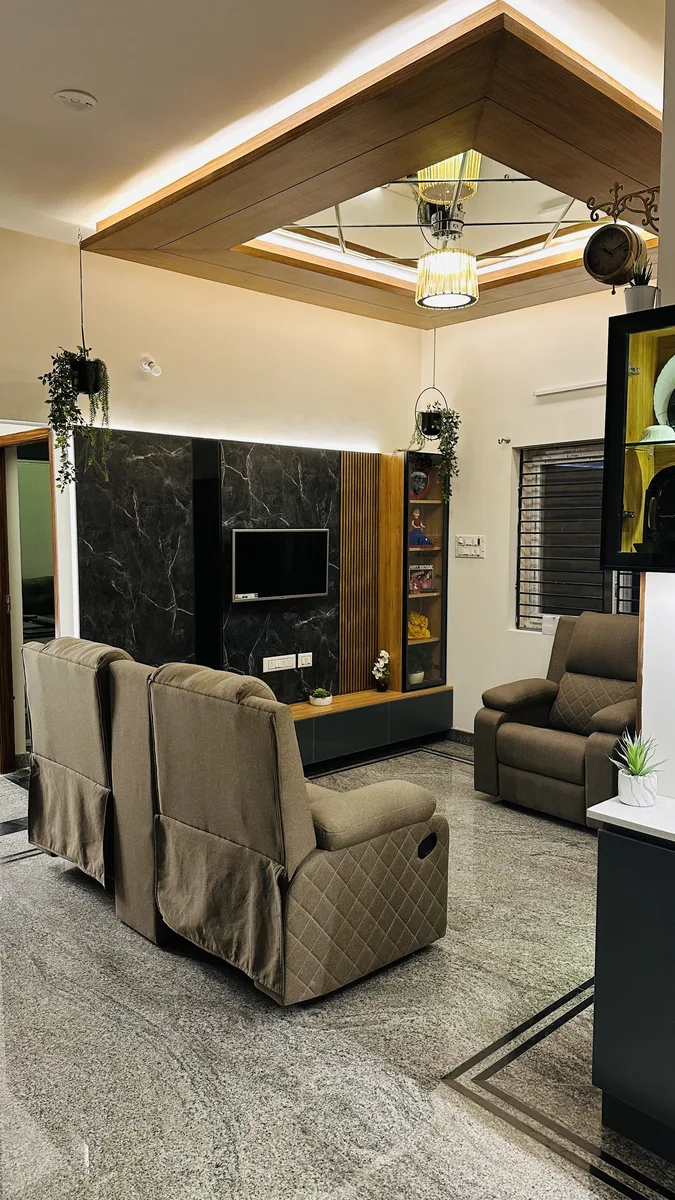
Veneer, PU and acrylic are only as stable as the board beneath them. A premium finish over a substrate that moves telegraphs every millimetre of that movement, and edge lift starts where end grain was left unsealed.
Book-matched veneer laid out and numbered before pressing, so grain runs continuously across a wall rather than restarting at each panel joint. This is scheduling discipline, not a material upgrade.
Natural stone selected and matched slab by slab rather than from a sample, so veining reads continuously across a run. Inlay and metal reveals get a dry fit before final fixing.
Concealed hinges, soft-close mechanisms and sliding gear specified to carry the actual shutter weight. Under-specified gear on a heavy veneer shutter sags within a year and takes the alignment with it.
Cove depths, driver access and beam angles resolved before fabrication. Retrofitting a fitting into finished premium joinery is where these projects acquire their visible compromises.
Stone sealing intervals, veneer cleaning restrictions and lubrication points for sliding gear documented at handover, so the finish is maintained rather than merely delivered.
Our delivered Bengaluru work is one villa interior. The high-specification portfolio sits in Hyderabad and Chennai. What transfers is method rather than local volume, and you should weigh that.
Execution drawings, material submittals, dry-fit approvals and a single sequenced programme are the same disciplines regardless of city, and they are what determine whether bespoke work lands cleanly.
Local supplier depth for specialist stone, metalwork and imported hardware is built city by city. In Bengaluru we would confirm lead times against your specification before committing to a programme rather than after.
A dedicated resident project manager, submittals approved before fabrication, and a written programme that names which items are long-lead. If that is not enough given our local record, that is a reasonable conclusion to reach.
Not the finish catalogue — both tiers specify veneer and acrylic. The difference is joinery designed to the specific space rather than adapted from standard modular sizes, higher-grade or imported hardware, stone and metal detailing that requires dry-fit approval, and a programme that sequences joinery, stone, glass and lighting as one trade instead of four.
One completed project in this city, a villa interior. Our high-specification portfolio is in Hyderabad and Chennai. The method transfers directly — submittals, dry-fits and a single sequenced programme are city-agnostic — but local supplier depth for specialist stone and imported hardware is built market by market, and we would confirm lead times before committing rather than after.
Genuinely bespoke, so a published range would mislead. For calibration, a 3BHK in standard premium specification is ₹16–26 lakh at August 2026 rates and Bengaluru runs about 5% above Hyderabad on labour and freight; this tier sits above that, driven by the extent of bespoke joinery, stone and imported hardware. We price from a detailed BOQ after a scope conversation and survey.
Longer than a standard fit-out, and approvals rather than labour are why. Veneer layout, stone slab selection and metal dry-fits each need sign-off before fabrication proceeds. Compressing that sequence is exactly where premium projects acquire the compromises that become visible later.
Yes, and it is common at this level. We produce execution drawings, material submittals and dry-fit approvals against the design intent. Where a specified item will not perform — under-rated gear on a heavy veneer shutter, unsealed stone at a wet junction — we raise it in writing with an alternative rather than build a known failure.
Less than the coastal cities, which is genuinely to your advantage: no salt-driven corrosion, so hardware choice is about load rating rather than corrosion resistance. What still matters is the June–September monsoon on outdoor-adjacent joinery, and sealed end grain everywhere, because unsealed edges draw moisture in any climate.
Send the drawings and whatever reference you have gathered. The first conversation we will want is about substrate, hardware and sequencing — plus an honest read on lead times for anything specialist.