Layered Lighting: Why One Bright Ceiling Light Ruins a Room
You can spend well on veneer, stone and hardware and still have rooms that look flat, because a single bright ceiling fitting flattens everything under it. Lighting is the cheapest element that decides whether the rest of the money shows — and almost all of it must be decided before the false ceiling closes.
The three layers
Ambient is the general light that lets you move around and read the room. Task is concentrated light where something specific happens — the kitchen counter, a study surface, the mirror, a reading chair. Accent is the light that picks out a surface or object: a wall texture, a niche, artwork, a plant.
A room with only ambient light is evenly lit and visually dead, because nothing has emphasis. A room with all three, on separate switches, can be a bright working space at 7pm and a low, warm one at 10pm — the same room doing two jobs. That switching flexibility is the entire point, and it is what a single ceiling light cannot give you at any wattage.
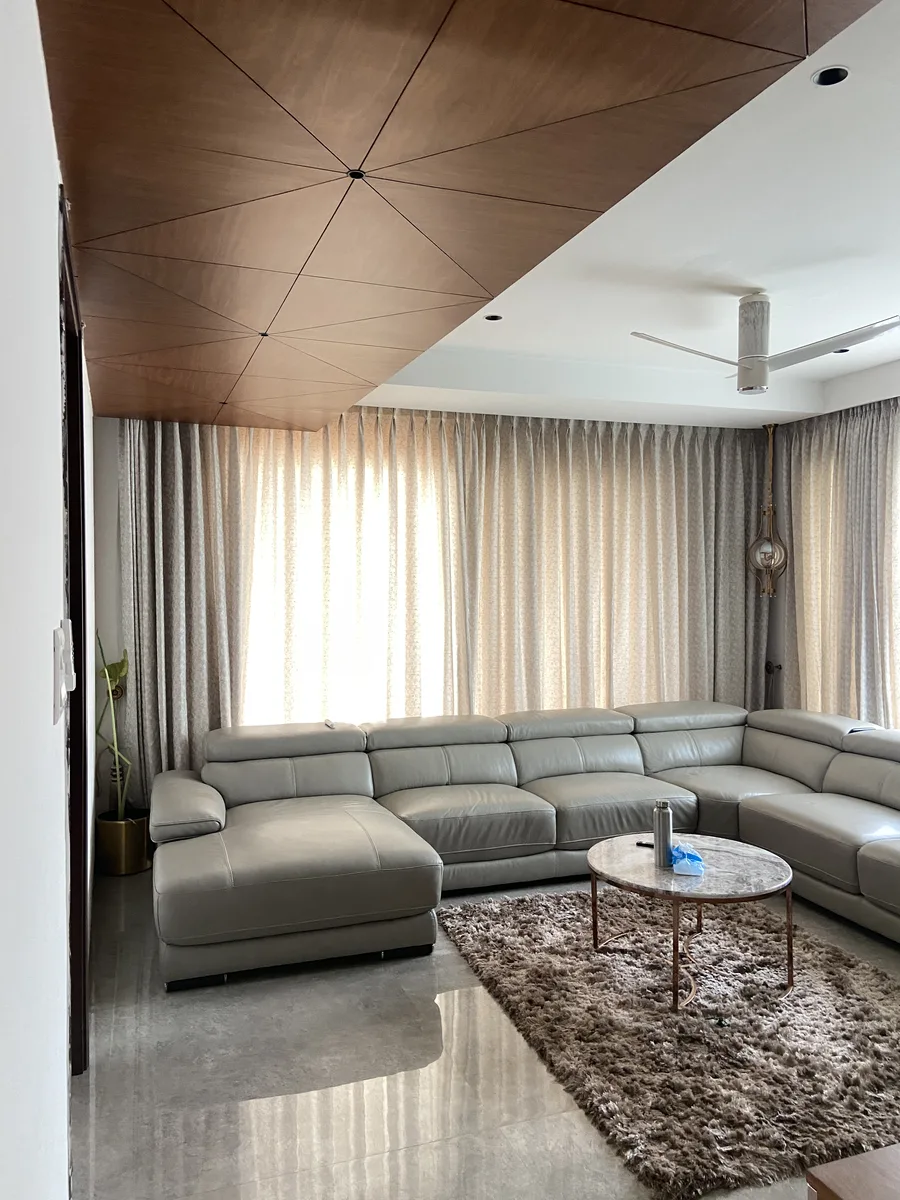
Circuits are the decision, not fittings
Fittings can be changed in an afternoon. Circuits cannot, once the ceiling is closed and the walls are painted. So the expensive part of a lighting plan is not what you buy but how it is wired:
- Each layer on its own switch. If ambient and accent come on together, you have one scene, not three.
- Two-way switching where you walk. Bedroom lights operable at the door and at the bed; corridor lights at both ends. This is the most-appreciated and most-forgotten provision in an apartment.
- Dimming where you will want it — living room ambient and bedroom ambient at minimum. Dimming needs compatible drivers and, in some cases, a specific switch, so it must be decided before purchase rather than assumed.
- A separate circuit for anything you may automate later. Retrofitting smart control is far easier when the circuit boundaries already match the way you use the room.
Common failures here are worth reading alongside this — see our guide to lighting mistakes.
Colour temperature: pick a rule and hold it
Warm light (lower colour temperature) reads as relaxed and flatters timber, warm laminates and skin. Neutral to cool light reads as alert and is easier for detailed work. Both are correct in the right place; mixing them arbitrarily within one sightline is what looks wrong.
A rule that works in most Hyderabad apartments: warm for living, dining and bedrooms; neutral for kitchen counters, study surfaces and bathroom mirrors; and never two different temperatures visible in the same view. Also insist that fittings on the same circuit come from the same batch where possible — nominally identical fittings from different production runs can differ visibly.
One caution specific to a warm climate: very cool white light does not make a room feel cooler, it makes it feel like an office. If the goal is comfort in summer, that is a shading, ventilation and finish question, not a colour-temperature one.
Where task light actually needs to be
The single most common task-lighting error is a downlight behind where you stand, so your own body shadows the work surface. The fix is position, not brightness:
- Kitchen counters want light from under the wall units, in front of the person, not from a ceiling fitting behind them. This needs a point planned at the right position — see the kitchen guide.
- Mirrors want light on the face, meaning either side of the mirror or above and forward of it. A downlight directly overhead lights the top of your head and shadows everything else.
- Reading positions want a directional source beside the chair or bed, aimed at the page.
- Study and work surfaces want light arriving from the side opposite your writing hand.
Accent light, used sparingly
Accent lighting works by contrast, which means it stops working when everything is accented. Choose two or three things per room, at most: a textured wall, a niche, the pooja space, a plant throwing a shadow.
Cove lighting deserves a specific note because it is so widely installed in Hyderabad apartments. Done well — a genuinely concealed source, a deep enough cove, a clean uninterrupted run — it gives soft indirect ambient light. Done badly it produces visible hotspots and scallops along the ceiling, and the giveaway is a cove too shallow to hide the source. If cove lighting is in your plan, ask specifically about the cove depth and the spacing of the strip, because those two numbers decide whether it looks smooth or spotty.
Glare is the thing people cannot name
When a room feels harsh despite reasonable light levels, the cause is usually a bright source in the field of view. Deep-recessed fittings, an anti-glare trim, indirect layers and directional fittings aimed away from seated eye level all fix it. This matters more with age, which is why it appears in our elder-friendly interiors guide as well.
The sequence, because it constrains everything
Lighting decisions have to precede two irreversible events: the electrical rework and the false ceiling. Points, circuits, switch positions and dimming provision are all set before the ceiling closes, and adding a circuit afterwards means opening it again.
Which means the lighting conversation belongs in the first fortnight after possession, alongside the layout — see the first 30 days sequence. It is the cheapest high-impact decision available at that moment and the most expensive one to revisit later.
Written by AlcorOne Solutions
AlcorOne Solutions is an interior contracting firm working across Chennai, Hyderabad, Bengaluru, Vizag and Rajamahendravaram. This guide was compiled by the project team from itemised BOQs, vendor quotations, and site records from our own fit-outs, and is reviewed by the partners before publication.
Sources & references.
Standards, regulatory registries, and manufacturer references that back the material grades, pricing framework, and compliance points in this guide:
Frequently asked questions.
How many downlights does a room need?
Wrong question, and asking it is how rooms end up with a grid of identical downlights and no character. Start from what happens in the room, place task light where the activity is, add ambient to fill, then one or two accents. The count falls out of that.
Is cove lighting worth doing?
Yes when it is detailed properly — enough cove depth to conceal the source, correct strip spacing, and clean runs. It is not worth doing as a shallow afterthought, because visible hotspots read worse than no cove at all.
Warm or cool white for a Hyderabad apartment?
Warm for living and sleeping spaces, neutral for task areas like kitchen counters and mirrors, and never two temperatures in the same sightline. Cool white does not make a hot room feel cooler; it just makes it feel like a workplace.
Can I add dimming later?
Sometimes, but it depends on the fittings and drivers already installed and on the switch wiring. It is far cheaper to specify dimmable drivers and the right switch from the start on the two or three circuits where you will actually use it.
What if the false ceiling is already done?
Then work with surface and portable light — track fittings, wall lights on existing points, floor and table lamps. A great deal can still be recovered, but any new circuit means opening the ceiling, which is exactly why this decision belongs before it closes.
If your false ceiling has not gone up, the lighting plan is still inexpensive. Send the layout and we will mark the three layers, the circuits and the switching positions — including two-way switching where you actually walk — before anything is closed up.
False ceiling not up yet?
Then the lighting plan is still cheap. Send the layout and we will mark the circuits, positions and switching before anything closes.
Get a callback + itemised BOQ
Leave your name and number — we'll call you back with a scope and a ballpark BOQ for your Hyderabad project. No obligation.